

The definitive guide to caller reputation

Understanding what determines your caller ID reputation, how spam labels work, and how to fix spam flagging issues

Hiya improved our answer rates nearly 2X, helping us increase conversions 50%. Caller Reputation gives us the visibility we need to ensure we’re engaging customers the right way.
Connor Mank, Founding Account Executive & Manager

The problem: Consumers aren’t answering and businesses don’t know why

Businesses have long struggled to connect over voice, not because customers don’t want to talk, but because trust has been broken. Here are some of the issues:

  • Consumers don’t pick up because their trust has been eroded by a bombardment of spam and fraud calls.
  • Businesses have no easy way to know if calls are being labeled as spam and why.
  • Teams can only guess why answer rates have dropped.
  • Until now, there’s been no easy way to see what’s really happening behind the scenes.

What determines my caller ID reputation?

The key factor in determining your caller reputation (sometimes referred to as caller ID reputation) is how recipients are reacting to your calls. When recipients answer your calls — and stay on the line to talk after discovering who is calling — it indicates that it is a wanted call, and therefore helps you build a positive reputation.

However, when recipients block your calls or hang up immediately after you introduce yourself, it indicates that your calls are unwanted, and that reflects poorly on your caller ID reputation. Every call you make is a data point that added together forms your reputation — for better or worse. A strong reputation means your calls are more likely to connect, your conversations more likely to convert, and your customers are more likely to trust your outreach.

For years, businesses have complained that their reputation as a caller has been a black box: that there’s no way to know what their reputation is, and even if they do know, they’re not sure how to repair a poor reputation.

Best practices for a healthy caller ID reputation

Improving your reputation isn’t about avoiding spam labels or hiring a caller ID reputation service to check phone number reputation. It’s about building trust with every call. And there are foundational best practices that can help any brand build trust with their customers.

Here’s a summary, taken from Hiya’s 10 Tips for Customer-Friendly Phone Calls:

  1. Keep your calling data clean – Use high quality, ethically-sourced call lists.
  2. Respect call frequency and timing – Limit how often and when you call to avoid appearing aggressive.
  3. Call with purpose – Focus on quality interactions instead of high outbound call volumes.
  4. Identify yourself clearly – Introduce your organization at the start of each call so recipients know who is calling and why.
  5. Monitor engagement – Track answer rates, average call duration, and complaints to spot reputation issues early.
  6. Respond to feedback quickly – If recipients mark calls as spam or complain, adjust outreach practices immediately.
  7. Be transparentRegister your numbers for free with Hiya to establish yourself as a legitimate business caller.
  8. Train your team – Make sure everyone making calls understands how their practices affect reputation.
  9. Stay consistent – Use the same phone numbers for the same types of calls. Frequently rotating numbers can look suspicious to spam analytics services.
  10. Consider branded caller ID – Displaying your business name and logo is an optional but effective way to help customers recognize who is calling so they can answer with confidence.

Learn more about branded caller ID.

Inside Hiya’s Caller Reputation solution

Hiya’s Caller Reputation is a new standard for measuring trust in voice communications. It reflects how the voice ecosystem — mobile network operators, analytics providers, and recipients — perceives your calling identity and behavior. Just as email has sender reputation, voice now has caller reputation. It’s influenced by factors such as:

  • Call patterns — The frequency, volume, and duration of calls.
  • Engagement — How people engage with live phone calls.
  • Feedback — Recipients blocking the calls or reporting them as spam.
  • Transparency — Whether your numbers are registered and confirmed to be from a legitimate source.

Hiya’s free Caller Reputation service is the foundation of a healthier voice ecosystem. It helps:

  • Businesses understand and improve how their calls appear.
  • Mobile Network Operators maintain safe networks.
  • Consumers answer with confidence.

By aligning everyone’s goals — visibility, trust, and protection — Caller Reputation redefines what’s possible in voice communication. It gives you visibility and guidance through two powerful features:

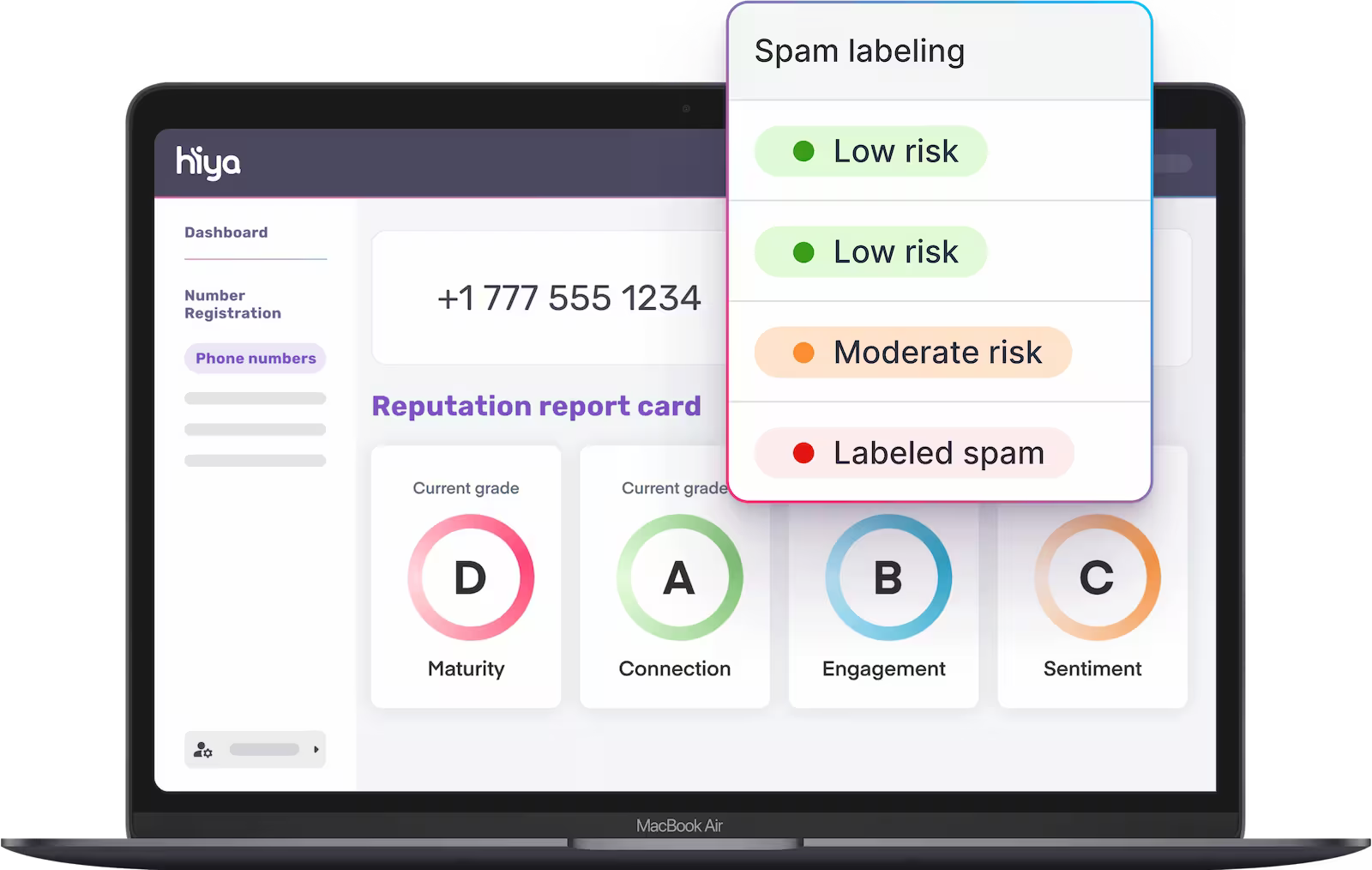
  1. Spam status: A real-time view of how your registered numbers are treated on networks that use Hiya’s spam labeling.
  2. Reputation Report Card: Simple A, B, C, D grades in four areas that affect your reputation: Maturity, Connection, Engagement, and Sentiment.

Understanding spam labeling and using the Reputation Report Card

Hiya Caller Reputation includes two very useful tools to help you understand your reputation: spam status and reputation report card. Use these to gauge your current status and to guide your roadmap to improvement.

Understanding your spam status

Spam status shows whether your numbers are being flagged on networks that use Hiya’s labeling.

Within the web console, Hiya provides a current spam labeling status for all registered phone numbers. This gives an indication whether calls from that phone number in the recent past may have been labeled as spam or if it’s likely that future calls will have that label. For example, depending on the phone carrier, the recipient may see a warning on their device such as “Suspected Spam” or “Spam Risk.” Knowing this is the first step to assessing your caller reputation. Caller Reputation shows spam labeling status as one of three possible values:

  • Labeled spam: This indicates a very high risk that calls from this number will receive a label as spam. Either Hiya’s spam call analytics service is currently set to label future calls as spam, or a majority of recent calls have been labeled in the past. This label might be shown on a brand new number as well, if Hiya’s service is concerned this number is being used to evade a spam label on calls made recently using a different phone number.
  • Moderate risk: Phone numbers with this status aren’t currently set to be labeled as spam, but there have been some calls (not most, but at least a few) that were labeled recently. It could be the number was previously labeled and isn’t any longer, or calls periodically receive a spam label.
  • Low risk: While no phone number is guaranteed to never be labeled as spam, these phone numbers aren’t currently being labeled and don’t have any real history of being labeled in the past.

Any phone number that is “Labeled spam” or “Moderate risk” is worth a closer look, as calls from that number have been impacted due to calling behavior and poor reactions from the call recipients.

Note: Spam labeling is dynamic for every phone call based on recent events, not a static property of a phone number. Therefore, not every call from a phone number may have the same label, and the spam labeling status is not a guarantee of future call labeling.

Using Reputation Report Card grades to review calling practices

If your calls are at risk of being labeled spam, a good first step is to review how those calls are being made and see why they might be causing such a poor reaction. The Reputation Report Card will help you do that. After you click on one of your registered phone numbers, you will see grades in these four categories:

  • Maturity: a reflection of whether a phone number is well established. A number is considered “mature” either if it creates a higher volume of calls, or if it’s seen creating calls over multiple days/weeks (even at very low volumes).
  • Connection: shows whether recipients of calls from this number tend to answer the phone when called from this number. It can indicate if the recipients are expecting or want to receive this call.
  • Engagement: reflects if recipients tend to stay on the line when they answer the call. It can be an indicator that recipients are engaging with the content of these calls and having a meaningful conversation.
  • Sentiment: reflects if recipients appear to want any lasting association with the caller. A poor grade here could be the result of recipients blocking the phone number from making future calls or reporting the caller as spam.

The Maturity grade is a window into your overall caller ID reputation. While a phone number is immature, spam labeling reflects the reputation of the company (since the number doesn’t have enough traffic to have its own reputation). So if you see an immature number labeled spam, it’s a clear sign that your company is struggling with a poor overall caller ID reputation. The Connection, Engagement, and Sentiment grades are all different ways to check phone number reputation because they measure how recipients are reacting to the calls this phone number is creating. A low grade (C or D) indicates that these calls have poor performance — worse performance than most other similar phone numbers. To address the spam labeling, it’s important to first address this poor performance.

How poor calling practices result in lower grades

The grades in the report card can help you go a step further to fine-tune your practices based on your own call performance. While every situation is different, the report card can provide some clues on which calling practices in particular might need a review. Please note, this is just an approximation and does not replace the need to follow foundational best practices for outbound calling, such as those covered in Hiya’s 10 Tips for Customer-Friendly Phone Calls.

Poor calling practice Explanation of the poor calling practice What you might see on your report card Why this practice hurts Actions to consider
Recipients weren’t aware they gave consent to be called. Perhaps lead collection didn’t make it clear to recipients that they’re consenting to receive phone calls (often consent is hidden in fine print). Connection: Poor
Engagement: Neutral
Sentiment: Poor
Recipients might understand why you’re calling if they answer, but they may also feel like trust has been broken. Make consent extremely clear, so the people you call are expecting that call.
Consent from leads has grown too stale Pursuing leads weeks after the individual originally expressed interest annoys recipients. Chances are high they’ve already chosen a different solution. Connection: Poor
Engagement: Very Poor
Sentiment: Neutral
Consumers don’t want to waste their time waiting for an agent to come on the line, and will just hang up. Ensure live agents are always immediately available.
Aggressive repeated call attempts Calling the same individual multiple times per day or multiple days per week. Connection: Very Poor
Engagement: Poor
Sentiment: Poor
Repeated calls are likely to annoy the recipient who has chosen not to speak further with you. Rather than aggressive calling, simply leave a voicemail message.
Delay during call connection The “hello” from the recipient is met with silence while the call center infrastructure connects to an agent. Connection: Neutral
Engagement: Very Poor
Sentiment: Poor
Consumers don’t want to waste their time waiting for an agent to come on the line, and will just hang up. Ensure live agents are always immediately available.
Overly-strict requirements to be removed from future calls Requiring the recipient to explicitly say, “Take me off your list” before you’ll stop attempting calls to contact them. Connection: Very Poor
Engagement: Poor
Sentiment: Very Poor
If the consumer is obviously not interested, it’s in everyone’s best interest to remove them from your list. Accept that being hung up on or your calls repeatedly dodged is a clear signal a call isn’t wanted, before the recipient reports you in frustration.
Failure to identify caller and purpose of call Leading calls with a simple “How are you today?” or mentioning only a business name they won’t recognize. Connection: Neutral
Engagement: Poor
Sentiment: Poor
Introductory small-talk wastes time. Recipients may hang up before they know who’s calling. Be very clear: “I’m calling from XYZ because you were interested in ABC”. They might end the call after that, but without hard feelings.

Caller Reputation as an industry standard

Hiya Caller Reputation isn’t just a product — it’s a movement toward transparency and accountability in voice. As adoption grows, a business’s calling reputation will become as essential to communications as credit scores are to finance: a clear signal of trust that benefits everyone in the ecosystem. We’re hoping it will become an industry standard.

Caller Reputation represents a new chapter for voice. It gives businesses the clarity to understand how they’re perceived, the tools to improve, and the confidence to connect again.

With Hiya, visibility replaces uncertainty, and transparency becomes the foundation of trust. Because when every call earns confidence, everyone wins.

Seeking a review of spam labeling?

If, after examining your Reputation Report Card and reviewing our 10 Tips for Customer-Friendly Phone Calls guide, you believe that spam labeling is inappropriate for your situation, you might choose to submit a request for your spam labeling to be reviewed.

You will need to submit a request to each carrier that is labeling your calls, as different carriers may use different spam detection services. For example, you may submit a request to Hiya if you feel your calls are being labeled by AT&T, Rogers, O2, EE, or by Samsung phones, among others. When in doubt, feel free to submit the request and Hiya will confirm if our caller reputation service is labeling your numbers.

  • How to submit: Visit Hiya’s Support Hub and choose the option “Report a call mislabeled as spam.”. Fill out the form, and provide all affected numbers (if more than one). For best results, use E.164 format like: +1 2065550123.
  • What to expect: Once received, Hiya will review the reputation of your phone numbers and based on sentiment we may be able to remove a spam label, but this change is not a rule: even if spam labeling is modified, your reputation as a caller still matters and poor calling practices will bring the spam label back.

More resources

Ready for your new Voice Performance Strategy?